SCALE BASICS
What Does 1/64 Scale Mean? Size, Scale and Box Scale
A practical explanation of 1/64 measurements, why models at the same scale have different lengths, and how box scale differs from strict scale.
QUICK ANSWER
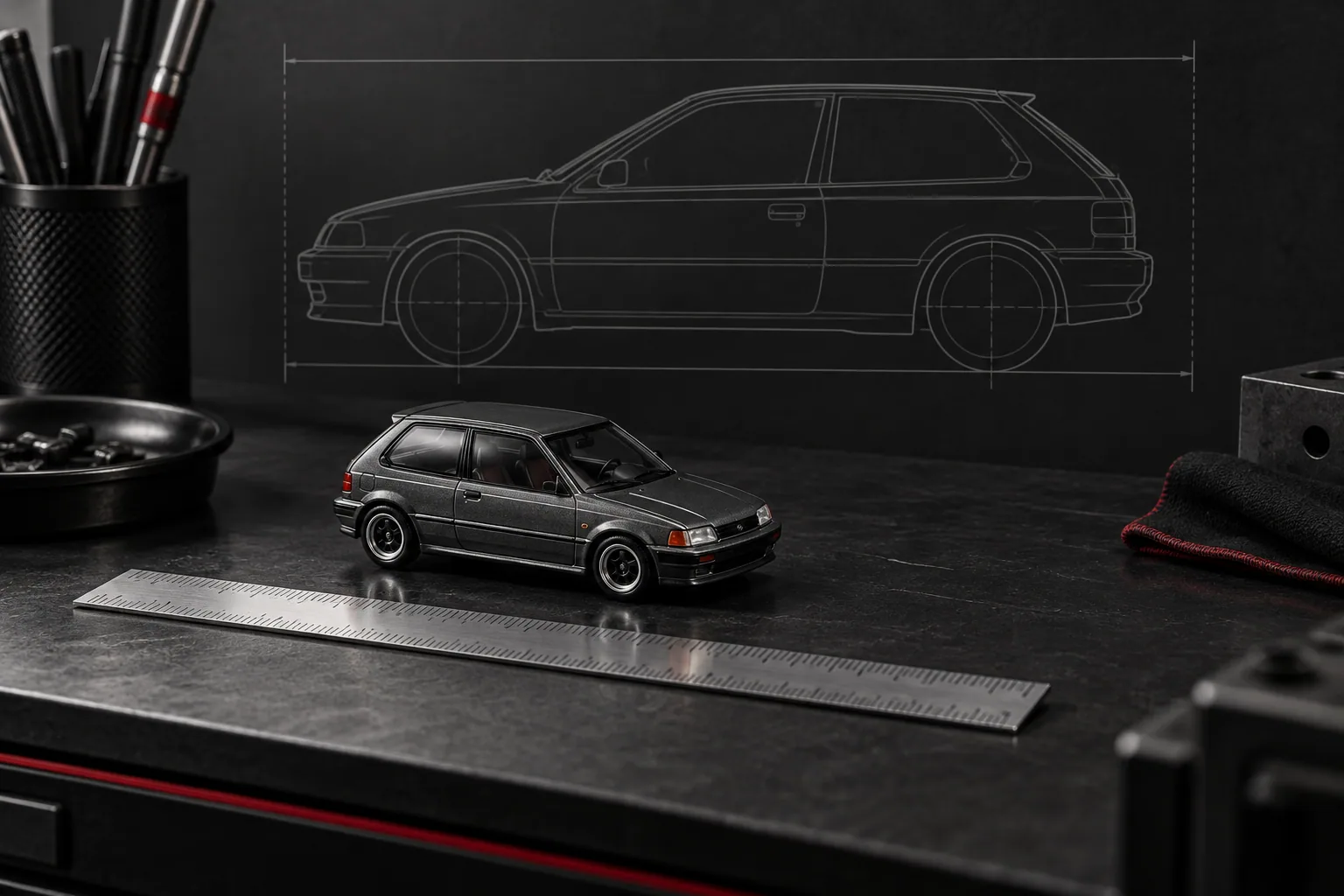
At 1/64 scale, every linear dimension is one sixty-fourth of the real vehicle. A 4,480 mm car would be 70 mm long in theory. However, many palm-sized toy cars adjust scale to fit a common package or track system.
- Calculate model size by dividing a real dimension by 64.
- Models at the same scale should differ in size when the real vehicles differ.
- Not every three-inch diecast car is an exact 1/64.
- Box scale prioritizes a consistent product format; uniform scale prioritizes real-world proportion.
- Check both the printed scale and actual dimensions when buying.
How to calculate 1/64
Scale is a ratio between a real object and its model. At 1/64, divide length, width and height by 64. Mattel’s scale guide likewise explains 1:64 as one sixty-fourth of the real vehicle.[1]
| Example real dimension | Calculation | Theoretical model size |
|---|---|---|
| Length 4,480 mm | 4,480 ÷ 64 | 70 mm |
| Width 1,792 mm | 1,792 ÷ 64 | 28 mm |
| Height 1,472 mm | 1,472 ÷ 64 | 23 mm |
NOTE — These are fictional dimensions used only to demonstrate the calculation.
Different lengths can still mean the same scale
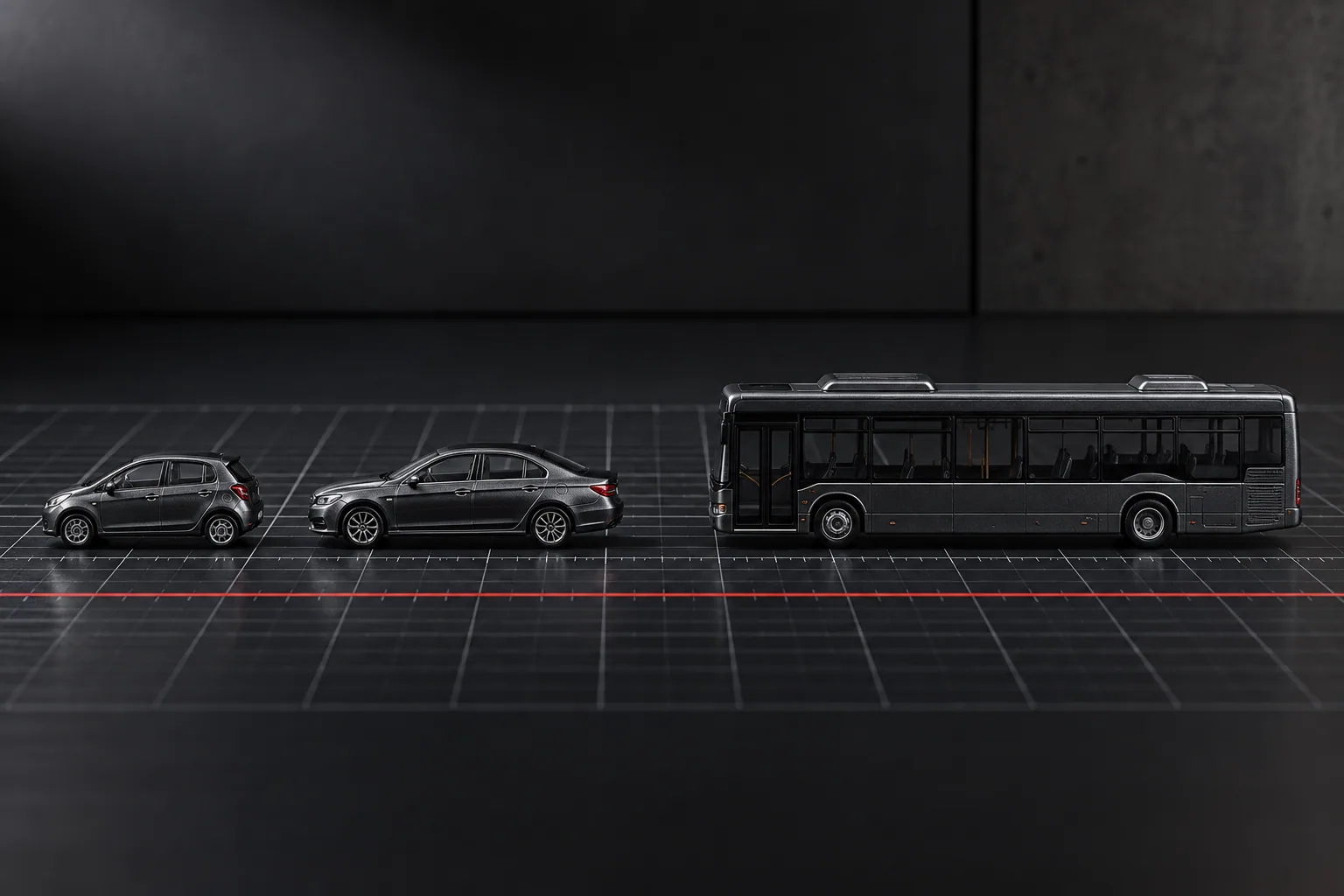
A 3.2-metre city car becomes about 50 mm long, a 4.8-metre sedan about 75 mm, and a 12-metre bus about 188 mm. A consistent scale preserves those differences.
Do not judge scale by comparing model length alone. Compare the model measurement with the verified dimension of the real vehicle.
Strict scale versus a palm-sized product format
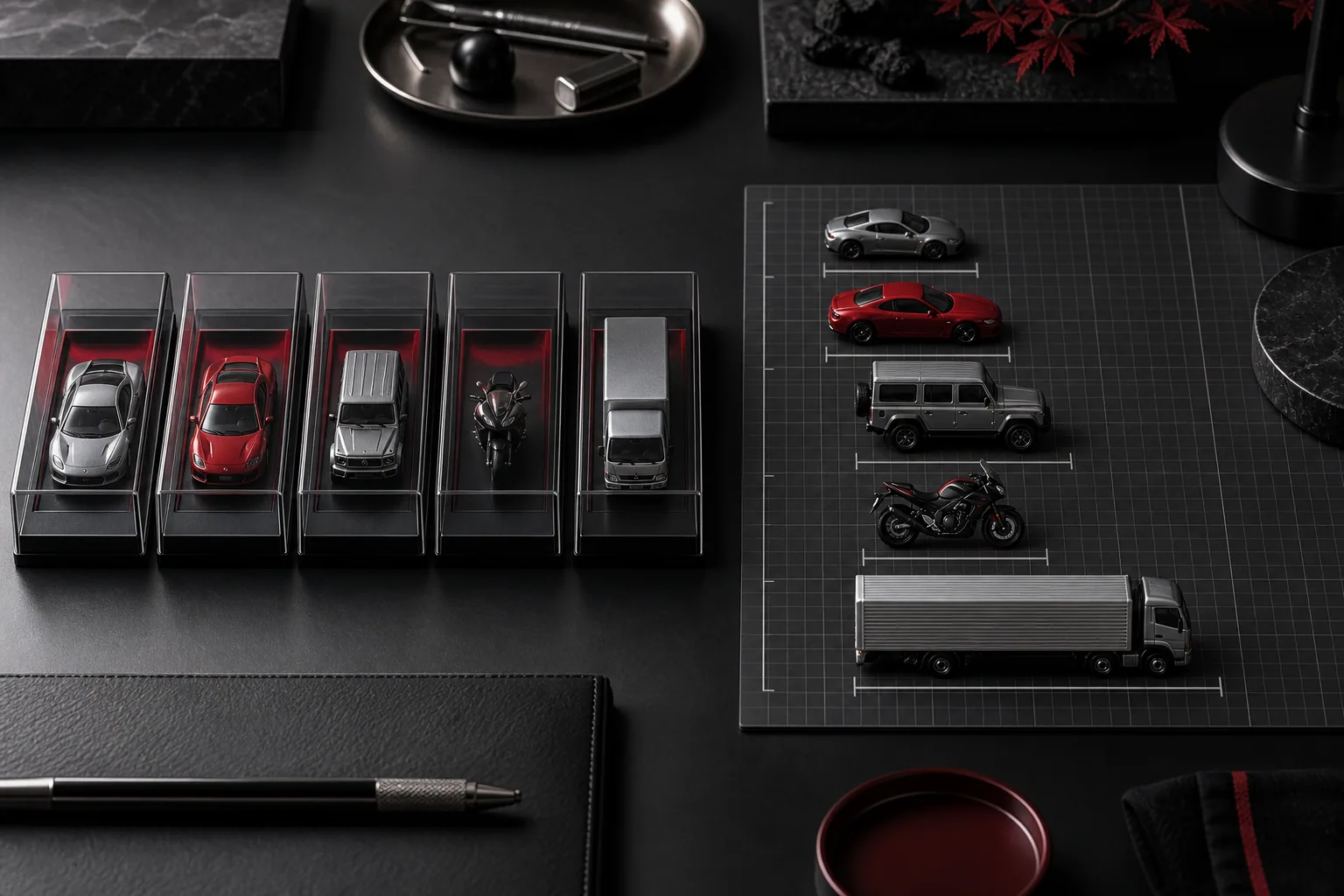
Toy lines often need every vehicle to fit the same package, track and small hand. A large vehicle may be reduced more and a compact vehicle less so. Collectors often call this box scale.
This is a design choice, not automatically a defect. Strict scale is stronger for realistic side-by-side display; box scale is often stronger for common play and storage systems.
Tomica makes the distinction easy to see
Tomytec states that standard Tomica models use different scales to fit a child-friendly size, while Tomica Limited Vintage keeps vehicles and figures at 1/64.[2]
Reading the base, box and official listing together is more reliable than assuming every vehicle in a small format shares one exact scale.
A practical buying checklist
- Look for a printed scale on the base, box or official product page.
- Check the model’s actual length if shelf or diorama fit matters.
- Decide whether you value realistic size differences or a common toy format.
- Treat “1/64-style” or “three-inch” as a size category unless a precise scale is confirmed.
Frequently asked questions
How long is a typical 1/64 car?
A real car between 3.2 and 5.0 metres becomes roughly 50–78 mm long. The exact model length depends on the real vehicle.
Is every Hot Wheels car exactly 1/64?
No. Hot Wheels is commonly associated with the 1/64 category, but many castings are designed around play, packaging and style rather than a single exact scale.
Can 1/64 models share an S-scale diorama?
Often yes, because S scale is commonly 1/64. Visual compatibility still depends on the model’s actual dimensions and proportions.
Sources and editorial policy
Reference links are listed below with the date used for this article. Linked pages may later change or move.
- Mattel — Die-Cast Cars and Trucks for Kids of All Ages (checked: 2026.09.14)
- TOMYTEC — tomica LIMITED VINTAGE TLV (checked: 2026.09.14)
- Takara Tomy — Tomica new products for February 2026 (Japanese) (checked: 2026.09.14)
Factual claims are checked against the sources listed above. We do not invent hands-on impressions of products we do not own. This independent publication is not affiliated with any manufacturer.